Contents:
- What is it
- Benefits
- Reflexology Lymph Drainage
- Reflexology in cancer care
- FAQs
What is reflexology?
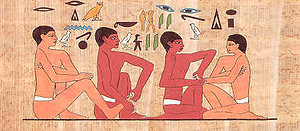
Reflexology has been around for thousands of years. It was practiced by ancient civilisations alongside other well being practices such as herbal medicine, bone-setting, tai chi, qigong, yoga, meditation, acupuncture, massage.
Reflexology was rediscovered in the Western World about 100 years ago. Through Eunice Ingham’s dedicated research and hard work her foot theory was developed and made known both amongst medical professionals and laymen.
"If you are feeling out of kilter, don’t know why or what about, let your feet reveal the answer, find the sore spot, work it out.” - Eunice Ingham
Unfortunately nowdays people in the Western world turn to complementary therapies only when things go wrong. But with a regular health maintenance programme - that includes healthy diet, regular exercise and any form of stress management - our lives could be much healthier for longer.
Reflexology is a non-invasive, drug free, natural complementary therapy that is safe for all ages.
During the treatment nerve endings are stimulated on the feet, hand or face with special thumb and finger techniques. This encourages better nervous communication and improves blood and lymph circulation throughout the whole body. As a result every single cell of the body will get a better supply of oxygen and nutrients. With this intent the negative emotional and physiological effects of stress are alleviated.
You will find yourself in a deep state of relaxation where the body’s innate healing power will be able to kick in and start restoring balance.
Reflexology works on a holistic basis – in other words it works on the overall health of the person rather than a particular symptom. It rebalances and resets your entire being – physically, mentally and emotionally.
What are the benefits?
Reflexology is a great stress buster!
Some of the other potential benefits are:
- - as no.1. it brings the mind-body into a deep state of relaxation which is a requisite for the body to do the necessary repair work
- - it creates a sense of well-being by eliminating tension
- - improves mood
- - melts anxiety
- - promotes better sleep
- - induces a deeper sense of harmony.
- We can all agree that a more relaxed mind-body is in a much better state to deal with physical and/or mental-emotional ailments. The Association of Reflexologists has a suggestion to healthcare professionals,
- MS
- Parkinson's Disease
- Dementia
- Anxiety
- Pain
- Cancer.
For information on pricing and to book please click here.
N.B. Reflexologists do not claim to diagnose, cure nor prescribe.
What is Reflexology Lymph Drainage (RLD)?
It is an award winning, research based Reflexology technique that was developed by Sally Kay through extensive clinical practice carried out in cancer care outpatient settings.
The aim of RLD is to regulate the lymphatic system to work better and thus ease the discomfort and swelling in the body.
RLD was developed by translating the Manual Lymphatic Drainage (MLD) protocol into a specific Reflexology sequence to improve lymphoedema.
Reflexology Lymphatic Drainage (RLD) may be used in a very similar way to Manual Lymphatic Drainage (MLD) to support conditions where the lymphatic system is implicated.
RLD can be performed on the feet or hands, with aftercare techniques shown on the hands.
The advantage of RLD over MLD is that the patient only has to remove his/her shoes and socks - that is if he/she is to have Foot Reflexology. With Hand Reflexology no clothing needs to be removed.
If you are concerned about swelling in your body or it comes on suddenly and unexpectedly please DO seek medical advice first.
For information on pricing and to book please click here.
Reflexology in cancer care
Every stage of the cancer journey, from active treatment to palliative care, impacts both body and mind in many different ways. I provide specialist oncology reflexology through gentle, compassionate treatments. Every session is fully tailored to your unique needs and how you feel each day.
My experience includes delivering deeply relaxing reflexology treatments in a clinical setting for 6 years at GenesisCare, Windsor, supporting patients throughout their journey. Shaped by this humbling and deeply fulfilling experience, my approach is gentle, flexible and fully committed to honor You. The treatments bring a sense of peace, may improve your sleep and ease some of the side effects of treatment such as constipation, hot flushes, peripheral neuropathy and lymphoedema.
If you have any questions or concerns please get in touch. A lot of sceptical patients became converts to this wonderful therapy and kept receiving sessions even after their cancer treatment ended because they found it beneficial for their recovery and overall well-being.
FAQs
Is it for me?
The only way to find out if reflexology is for you is to try it.
If you are unsure whether you would benefit from some sessions please do reach out. I am more than happy to answer any questions you may have without any obligations.
Foot, hand or facial reflexology?
If you don't like your feet being touched or feel embarrassed about them - well, there is a solution: why don’t I work on your hands or even better on your face!
Hand reflexology is very similar to reflexology done on the feet.
The Vietnamese style facial reflexology, that I practice, is very gentle. It involves a little bit of oil spread on your face to allow for a smooth glide of my fingers and the crystals I use.
What happens in a reflexology session?
Before the first session a confidential medical consultation will take place also covering the life style you live. You’ll be asked to sign a consent form to express your agreement to the treatment. All confidential information is stored securely.
As only your feet will be worked on there is no need to remove any clothing, only your shoes and socks. If the feet cannot be worked on the hands will do too.
You’ll be seated on a reclining chair and covered by a warm blanket to maintain a comfortable body temperature. Your feet will be first cleansed and warmed up by some massage techniques. This will be followed by the actual reflexology treatment consisting specific thumb, finger and knuckle pressure techniques that are adapted to your individual needs. It should not tickle or be painful however some discomfort might be felt. The whole treatment should feel deeply relaxing.
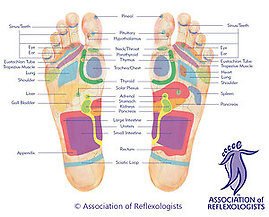
A professionally trained reflexologist can detect subtle changes in specific points on the feet, and by working on these points may affect the corresponding organ or system of the body.
Every treatment is tailored to individual needs according to the presenting conditions on the day. The treatment is given and then with the help of this deep state of relaxation achieved the mind-body itself will decide what to do with it and how to use it to its own advantage.
How will I feel after a session?
After the first couple of sessions of deep relaxation you may find that your sense of wellbeing has improved and you feel full of energy. However it is not unusual to experience healing reactions - such as tiredness, needing the bathroom more often, headaches, excessive sweating, your aches and pains become more troublesome etc. These should pass within 24-48 hours. They are a good sign that your body has the necessary vitality to throw off the toxins that were released into the blood stream during the treatment. These healing reactions will become less and less noticeable and eventually as your health improves thanks to reflexology treatments you will feel full of energy, will sleep better and will notice a feeling of improved mood and general wellbeing.
For information on pricing and to book please click here.
Aftercare advice
It is recommended to drink plenty water after each treatment to help the kidneys flush out these toxins and to take it easy for the rest of the day if you are feeling tired.
To maximise the benefits of each session I encourage you to give me any feedback you may have during and following the sessions.
How many treatments do I need?
It is the cumulative effect that sees results. Just like one doesn’t get an abdominal six pack by going to the gym only once.
For an acute condition a course of 4-6 one-hour treatments are recommended at weekly intervals. During these treatments the deep state of relaxation will ensure that the body reaches its maximum innate healing potential to rebalance itself. Once this optimal state is achieved treatments can become more spaced out.
For chronic conditions the length of a session, the frequency and the length of the course of treatments may be different depending on many factors, primarily on how long this chronic condition has been presenting itself and how your body reacts to treatment.
N.B. It is possible to have the treatments less frequently than every week from the start, but it will take longer to achieve good results.
For information on pricing and to book please click here.
Back to the top of this page